Slow sync is a feature available on a wide range of digital cameras that enables you to fire the flash at lower shutter speeds. It permits you to keep shooting in a variety of low-light situations, thereby opening up new possibilities. By using slow sync flash, you can get a properly illuminated subject/foreground, yet still have the low ambient light in the foreground and background register in your frame. Many digital cameras let you set slow sync flash manually, but even on point and shoot cameras you have the ability to shoot at slow sync. In order to shoot slow sync photography, you need to preferably have a dark background and a soft box to be able to see the object. The modelling light in the soft box records the blurred movements of the subjects and the flash freezes the image, capturing the still sharp image.

This photograph demonstrates the slow sync technique but not in regards to shooting in a studio. Instead this is a black and white photograph of a waterfall. Due to the slow sync the water seems almost smooth in texture and misty as it falls off the rocks in various lines. However there still is a sense of a dark background through the rock face which is virtually black and allows the form and shape of the water to be enhanced. This great contrast gives a similar effect as to the one applied in the studio. The is a sense of depth through the way the water bends and how the rocks get smaller towards the right of the composition.


The two images above are very similar as they both present the same subject matter of dancing. They both have black backgrounds which amplifies the shape and form of the subjects. These backgrounds are very effective in showing the blurred/smudged streaks and lines which represent the movement of the subjects. Within the blurred areas, various shapes can be seen which show the different stages of the subjects body movement. The contrast between the shadow and highlight areas are very effective in showing the form of the dancers' bodies. Also the arms and legs are very straight and direct which give a sense of lines. However there is a slight difference in the compositions of the two images as the first one is portrait and seemingly closer than the second image. This work effectively as is work accordingly with the dance move due to the subject jumping. This differs to the second photograph as it is landscape and more zoomed out which allows the dancers forwards/sidewards movement as the blurred lines streak to the left of the sharp frozen image.

This is another photograph which was shot in the studio with a black background but instead of showing the movement of a human or an object, it shows the movement of an animal and in this case a bird. There is a frozen image in the centre of the composition consisting of the main body of the bird and the fact that the bird is white allows it to stand out and allows for the movement to me seen evidently. There are arching lines which begin at the bottom of the birds body and end towards the top of the frame. This gives the impression of the bird's wings moving in order to fly. Along with the positioning of the birds head and the blurred section underneath the bird, the overall feel is that the bird is ascending.

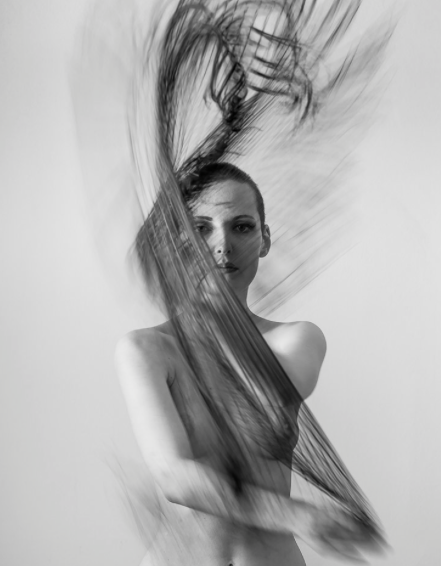
In this image a different approach has been made. Instead of using a dark background, a white background has been used. Usually with slow syncs a dark background is used with a light subject so there is a clear contrast which allows the movement to be seen. This picture acts as a invert to this method as there is still a contrast present which allows the movement to be seen but just in the opposite way. Here the frozen image is a woman which is looking directly at the camera whilst seeming to be waving an object about. The dark object causes dark lines to be made to make it apparent what direction it is travelling and also provides a sense of shape and from. There are thinner/smaller lighter lines which appear to be further away and provide a sense of depth.